Today In Climate: Voices from Energize NEXT 2025


View photos from Energize NEXT 2025.
On September 17, Energize Capital hosted our third annual Energize NEXT conference in Chicago, gathering more than 200 entrepreneurs, corporate executives, and investors to take stock of one of the most transformative moments in the history of energy and industry. Conversations circled around record electricity demand, surging AI workloads, and wide-scale industrial digitization, and how these forces are reshaping how we build, fund, and operate the next generation of climate companies.
At Energize, we call this the Demand Era—a phase where growth is no longer driven by incentives, policy, or incremental innovation, but by fundamental market demand for power, digitization, and resilience. For nearly two decades, clean energy technologies advanced through cost declines and gradual adoption. Today, those technologies are being pulled forward by an unprecedented appetite for electrons and efficiency.
Global investment in the energy transition surpassed $2 trillion in 2024, marking the start of the largest capital cycle since World War II. AI hyperscalers alone have increased their capex from 12% to more than 25% of revenue, accelerating demand across every link of the energy value chain from generation and transmission to digital infrastructure.
Energize Managing Partner John Tough described this moment as an inflection point where climate technology moves from a niche to a necessity, and where every business model, every innovation, and every sector must work in tandem to meet the scale of demand ahead. As Invenergy CEO Michael Polsky told the audience:
“The tailwinds propelling our industry outweigh the headwinds. If I could choose any moment in my career to be in energy, it would be right now.” - Michael Polsky, CEO, Invenergy
The discussions that followed balanced optimism with urgency: the energy transition has never had stronger market pull—or higher stakes. Here are a few takeaways from the day’s discussions:
1. The energy transition is accelerating, and it requires a diverse, flexible generation mix.
Speakers emphasized that there is no single technology that can meet the scale of today’s energy needs. Solar continues to set the benchmark as the lowest-cost form of generation, wind remains a cornerstone of global clean power investment, and emerging baseload technologies—including storage, nuclear, and geothermal—will all be required to balance the grid.
Speakers highlighted that even in conservative demand scenarios, renewables development over the next four years is expected to outpace anything seen before. The opportunity is one that will require diverse generation sources, horizontal tools, and flexibility to meet the growing market.
A market for renewable generation:
“We’ve seen over $80 billion of asset M&A transactions in the power sector this year. We’ve not seen this size, scale and speed of transactions in a long time. I believe we’re in a higher-for-longer scenario for power prices, which is incredibly good if you’re building new wind, solar, or storage.”– Bala Nagarajan, Managing Director at S2G Investments

2. Transmission and interconnection are a crucial bottleneck.
The pace of clean energy deployment is increasingly constrained not by generation, but by interconnection. Transmission queues are oversubscribed, permitting delays are widespread, and utilities face requests from tech customers who want gigawatts of power delivered in years, not decades.
The enduring need for T&D:
“The energy transition depends on the entire ecosystem—generation, storage, and efficiency all working together. But no matter which technologies advance, transmission and distribution are the backbone that make scaling possible. That’s why at Peachtree we focus behind-the-meter, where we can directly shape outcomes.” – Matthew Wilkes, CEO of Peachtree Infrastructure
Optimizing interconnection studies:
“Currently, when you talk about load and generation, those interconnection processes are studied separately. If you could combine those two such that you could jointly study the impact of both new generation and new load at the same time, I think you’d find that you could add a lot more capacity—cheaply.” - Max Kanter, CEO of Grid Status.
3. AI is changing the game, but it comes with costs.
Artificial intelligence has become both a driver of energy demand and a part of the solution. Data centers are straining local grids, while startups are leveraging AI to speed up product cycles, compress permitting, and optimize assets. Speakers also cautioned that rapid growth creates new risks. Higher energy costs, infrastructure delays, and policy uncertainty could slow momentum unless addressed with urgency.
AI for price forecasting:
“We operate over a gigawatt of energy storage assets in Texas and California, and our primary use of AI is in electricity price forecasting—to inform decision-making, bidding, and scheduling of battery assets. Thanks to advances in time-series forecasting and AI, we can now adapt much more quickly to changing market dynamics.” – Michael Baker, CEO of Tyba
AI as an asset for scale:
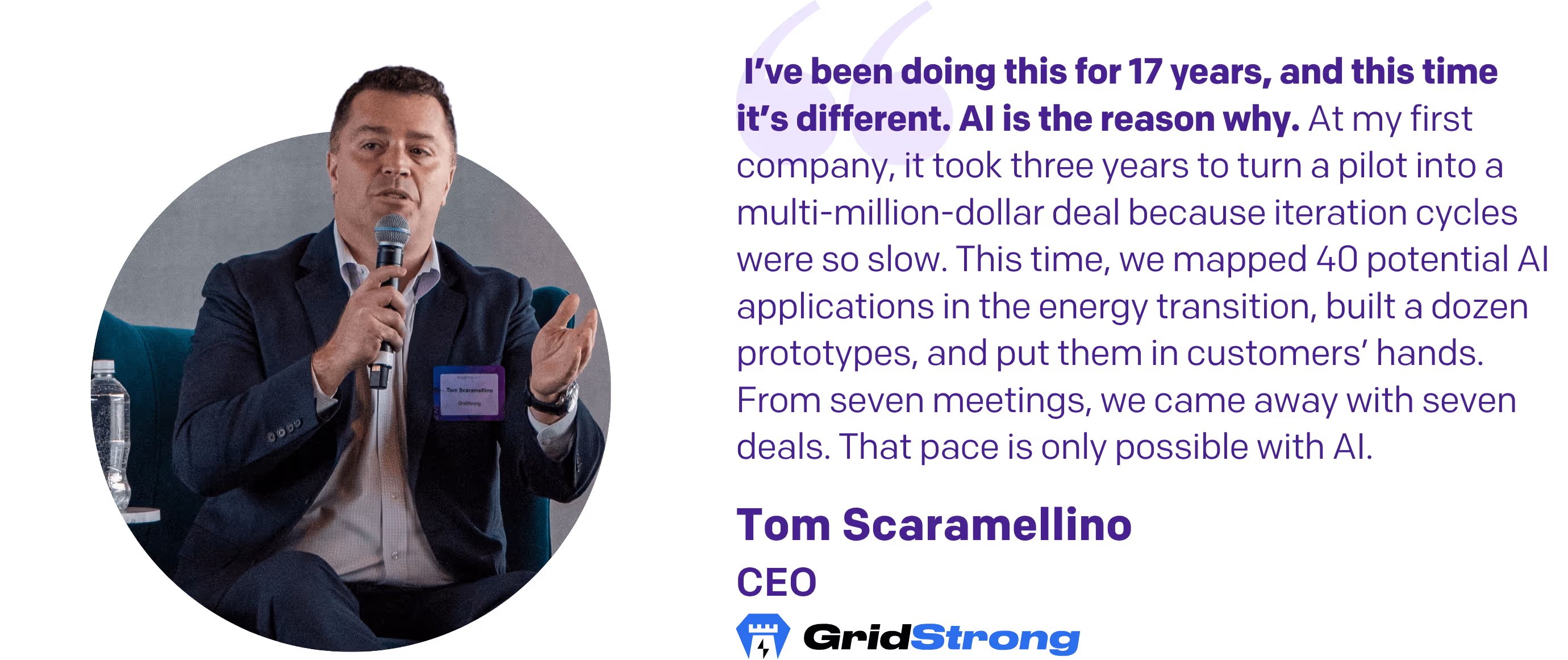
"I’ve been doing this for 17 years, and this time it’s different; AI is the reason why. At my first company, it took three years to turn a pilot into a multi-million-dollar deal because iteration cycles were so slow. This time, we mapped 40 potential AI applications in the energy transition, built a dozen prototypes, and put them in customers’ hands. From seven meetings, we came away with seven deals. That pace is only possible with AI." - Tom Scaramellino, CEO of GridStrong
Data centers as grid resources:
"AI demand is driving much of today’s load growth challenges, but it also opens up new angles. If data centers can become more flexible and operate as grid assets and resources, there's an exciting opportunity there. At the same time, a growing wave of startups is using AI-driven solutions to help manage these particular challenges, which creates a virtuous cycle.” - Natalie Valentin, Commercial Lead, GRIDSIGHT
4. Founders and funders are navigating a new investment cycle.
Climate capital markets are showing early signs of equilibrium and maturation. In the early stage, investors are focusing on traction over technology—backing founders who can prove adoption, revenue, and repeatability. The “missing middle” between pilot and scale remains a challenge, but the companies breaking through are doing so with sharper market timing, faster iteration cycles, and clearer customer alignment. Many investors described this moment as one of maturity: technologies are proven, customers are sophisticated, and investors are disciplined.
Later-stage investors, meanwhile, are navigating a different tension. Deal activity is rising, but competition for high-quality assets is fierce, and valuations remain high. Corporate carve-outs and spinouts are emerging as new sources of opportunity, while firms are increasingly willing to build earlier rather than wait for perfect scale. The new cycle is defined not by scarcity of capital but by selectivity—investors are underwriting to operational excellence, predictable cash flows, and durable customer value.
Maturing technology markets:
“This cycle, especially on the energy side, is different from past cycles. For the first time in literally decades we’re seeing material, aggressive load growth. At least on the energy side, we’re past the trough of disillusionment, and we’re climbing up the other side. A lot of the technologies we’re seeing are not things you would have seen five or ten years ago. Now is the right time — technologies are mature, customers are real, and you’re really starting to see traction.” - Josh Posamentier, Managing Partner at Congruent Ventures
5. Grid software is going mainstream, and utilities are on board.
Software is no longer a peripheral tool in the energy transition—it’s becoming the operating system for how utilities, developers, and grid operators keep up with unprecedented complexity and demand. From AI-enabled forecasting to grid optimization and asset management, digital tools are now indispensable for planning, deploying, and operating modern energy systems. The sector’s growing trust in software reflects both urgency and necessity: utilities can no longer rely on manual processes or incremental pilots to meet the pace of change.
For years, startups selling into utilities described the process as “death by pilot,” but panelists now see a turning point. Sunny Elebua, Senior VP and Chief Strategy Officer at Exelon, described how the utility is taking steps to shift out of a traditional gatekeeping role and into that of a software partner and accelerator. With growing pressures to improve service without raising costs, utilities across the board are implementing new technologies to safely shorten the distance between energy demand and supply, optimize grid performance, and deliver better outcomes for customers.
A new wave of grid management:
“We’re really starting to see where software can be used across grid optimization situations. The grid is so critical—it must be up and running for lives and livelihoods—and we’re finally at the point where software is being trusted to manage those critical grid functions. You can’t keep running the energy transition on PDFs and spreadsheets.” - Allison Myers, Chief Growth & Sustainability Officer at HData

Conclusion
The 2025 Energize NEXT conference underscored a defining reality: the energy transition is accelerating, broadening, and becoming more digital. Challenges in infrastructure, policy, and markets remain, but this event made it clear that the climate community shares a vision that the future of climate solutions is bright.




Let’s Build What’s Next